by Aaron Moore | Dec 27, 2014 | Graphic Design
The Importance of Typeface Choice
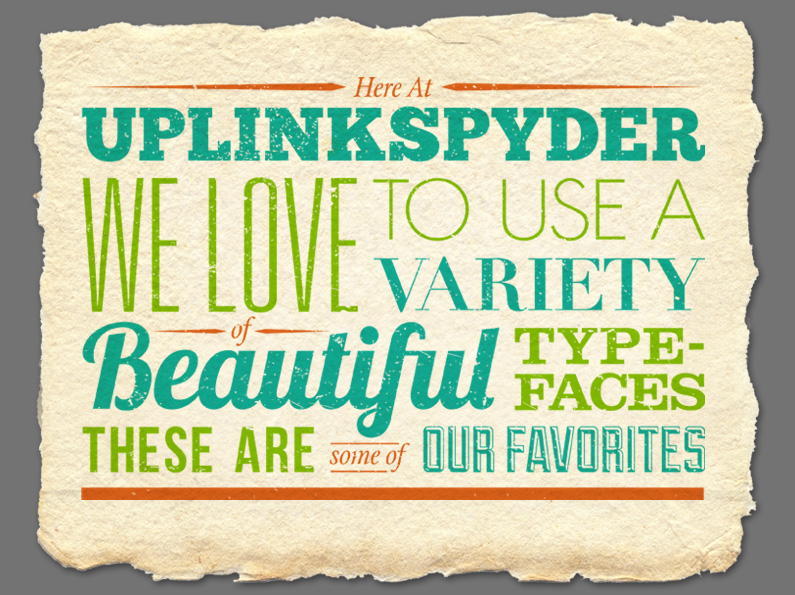
There are hundreds of thousands of typefaces floating around the web, and new fonts are crafted every day. Typefaces range from standard serif like the well known “Times New Roman” to an even more frequently used sans-serif like “Helvetica,” to script typeface, which resembles cursive handwriting.
In some cases, styling distracts from what is being said or limits readability. One thing is for sure, each tells a unique story. Aside from color palette or images used, a font can really set the mood for a reader.
At UplinkSpyder we love to have fun with design while maintaining readability and an appropriate setting for the message. Many of our favorite fonts are fairly versatile and present vastly different types of content in an effective way.
For any given organization and graphic design, not all fonts fit the bill. You wouldn’t want to use a dainty script on a hunting website where a rugged slab-serif would better suit the audience. It is important to choose the appropriate font because words can be saying one thing and the font choice can make the reader feel something very different.
Branding
Once you have the set of fonts that express the feeling and message you want, along with colors and a logo, you have the visual representation of your brand.
Once your brand is established and you want your website to reflect that brand, it can get a little tricky. Although web development possibilities grow constantly, it is still difficult to use some fonts organically on a website.
Nothing on the web is as easily manipulated as it is on a poster, but there are sneaky ways of getting the right feeling through use of your chosen fonts in website graphics. Headers, backgrounds, slideshow images, buttons, and other graphics can use any font and styling since they are created in graphic design programs.
When you integrate your brand in this way, you can choose a web-safe font to present content and still set the right tone & mood.
by Administrator | Dec 19, 2014 | Marketing, Strategy
The Christmas shopping season is one of the busiest and most important times of the year both for our clients and our company. In order to get the most out of consumers’ expanded need to make purchases this time of the year, retailers and marketers need compelling holiday campaigns across multiple channels. The same strategies apply throughout the year as other holidays and opportunities arrive. Other seasons and celebrations can be equally if not more important to you and your business and unlike Christmas, may not have as much competition for your consumer’s attention. The following helpful tips and strategies should be considered when creating any marketing campaign around a specific season or celebration.
Plan Ahead: Don’t start planning your marketing strategies days or even a few weeks before certain holidays. Planning your holiday campaigns a few months in advance will give you time to adjust to any changes and won’t have you throwing rushed, low-quality campaigns together at the last minute. Create a schedule and include specific weekly and daily tasks for each channel. Create assignments for people in your organization.
Be Creative and Generous: Use your creativity and the various channels at your disposal. A few ideas we’ve had success with include:
- Run a Facebook exclusive promotion that you only post and promote on your Facebook page for your fans.
- Use Pinterest or Twitter to run a re-pinning or re-tweeting contest for your followers.
- Send out weekly or daily newsletters counting down to the big day that include a deal in each.
- Offer larger promotions specific to well-known shopping days like Black Friday, Small Business Saturday and Cyber Monday.
- Create a “Last Minute Gift” promotion closer to Christmas. Most people shop online now, so offer promotional codes and make sure these codes are working before sending them out to your audience.
Engage Your Audience: Make your customers and fans feel special. Ask them via Facebook or Twitter what products they want or would like to see more of for the holidays. Use unique hashtags for them to use to interact with you. Consider running a photo contest or a “Caption This Photo” contest and have them submit their own photos or sayings. This makes them feel special, but more importantly it keeps them coming back to your page.
Show You Care: Show your customers and fans that you are a considerate and philanthropic company. You can start by partnering with a local charity or non-profit organization. Host a donation drive or volunteer at a charity event that benefits this organization. Helping those in need shows your audience you care about more than just sales.
Be Festive! Your clients are showing their spirit, so why shouldn’t you? Create festive graphics to utilize across all channels, including your website. Decorate your place of business and post photos of the décor and your happy helpers (employees). In the midst of all the promotions you are running, your audience will appreciate the occasional “fun” post or photo. It is also smart to create a special newsletter to send out. Something as simple as “Happy Holidays from All of Us” or “We are Thankful for You” shows that you appreciate their patronage.
Hopefully these tips will help you get an idea for a successful holiday campaign. Start planning your marketing strategy for the next holiday, celebration, or season using engaging and creative campaigns that will excite your audience and give you more brand awareness and sales.
by Deanna Rivera | Jan 3, 2014 | Content Creation, Search Engine Optimization
If you are spending time writing a blog or a page for your website, you want to make sure that people actually read it and that you get the most out of it where search engines are concerned. With that in mind, please consider the following.
Readability
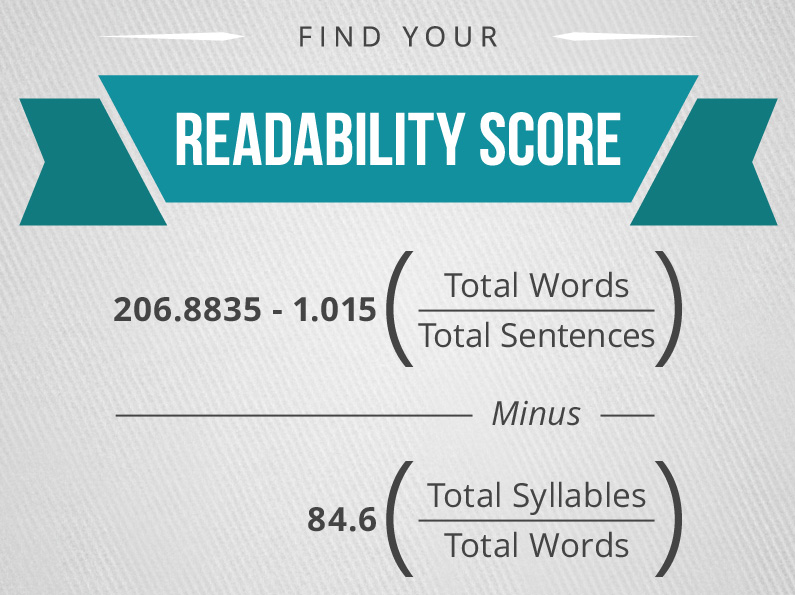
The math equation in the graphic below may have already sent you running scared from this blog. But if you want to know whether your blog will actually be read by most users of your website, pay attention. Luckily, if you have MS Word, you don’t have to do any math (look at the bottom of this blog for instructions.)
The math equation is called the Flesch-Kincaid Readability Score and it ensures you are writing in plain, understandable English. It’s important when writing for the web because psychologically speaking, people don’t want to do as much mental work reading your website as when reading a novel or newspaper.
In other words, keep it simple and they might stick around longer.
Readability Part 2
- Use white space, bullets, numbering, and good punctuation.
- Keep your sentences and paragraphs short.
- Use appropriate jargon. For instance, since ours is a technology related site, I could feel safe referring to search engine optimization or readability scores.
Search Engine Optimization
You really should leave Search Engine Optimization for the most part to your experts (hey, that’s us!) but when writing content, here are a few things anyone should do:
- Web crawlers can’t read images so tell them what the image is and include at least one keyword.
- Your title is the first thing the search engines read, so think about it and put a keyword or two in there, also.
- The same keywords in your picture and title should also be in your text.
For instance, for this article, my title keyword is website content and my image keyword is website readability. Hey look, those keywords are now in my blog a couple times. Yay me.
Figuring your Flesch-Kincaid Readability Score
Just in case the math equation still scares you and you don’t have MS Word, here’s a simple way to figure your score:
- Multiply the average sentence length by 1.015
- Multiply the average word length by 84.6
- Add the two numbers
- Subtract that total from 206.835
You want your score to be somewhere between 60-70 generally. 0-30 is WAY too high level for the average blog. 90-100 is probably too simplistic.
Here’s how you figure your score in MS Word:
- Go to Word Options
- Choose Proofing
- Ensure that the grammar with spelling box is checked
- Select the tick box for “Show readability statistics.”
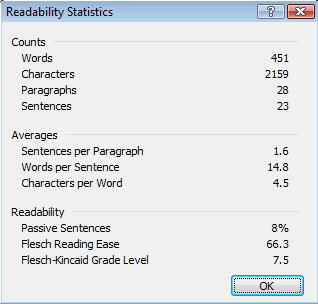
Just in case you were wondering, the readability score of this blog is 66.3. Nailed it.
by Deanna Rivera | Jan 7, 2013 | Website Design
We meet too many business owners that have attempted to build their own website. They usually come to us after months or even years of frustration, struggling with something that doesn’t look quite right or with complaints that no one can find them or they can’t add more content without spending hours inside of a janky system that never works quite like you expect.
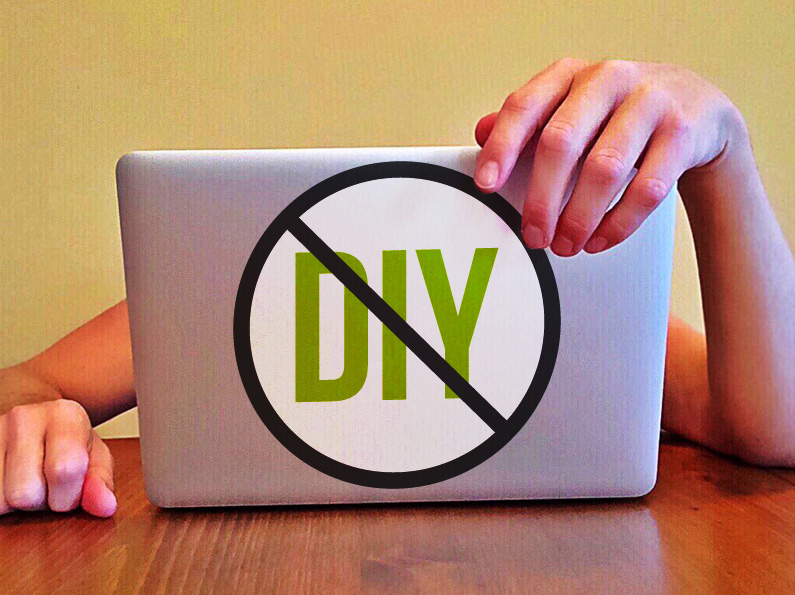
We suggest you save yourself hours of aggravation and more money than it will ever be worth and do it right from the start by hiring a professional. In case you need a few more reasons why that’s the best path…here are our top four reasons you should not make your own website.
#4. Placeholder vs. Website
If you build your own site, you will more than likely be creating something that should not be called a website. It should be called a placeholder because that is about all it will do for you: hold your place on the world wide web. We often refer to this as an “online business card.”
Your new “site” might tell people a little about you if they happen to search for exactly your business name. If you want your website to do more than that, as any good website should, then you should not make it yourself. We have not yet reviewed a “do it yourself” system that is worth any money, regardless of how little.
If you are dead set on going it alone, you will be better off getting a free account on Blogger and listing your business in a few online directories.
#3. You Might Actually Want To Be Found
If you build your site on your own, the chances of being found when someone searches for your services are close to the same as finding your way through a maze blindfolded. Not just any maze…one of those big corn mazes they have at Halloween. Make that one of those big HAUNTED corn mazes.
The internet is huge and search engines get frustrated pretty easily and the mess of code they run up against in “do it yourself” scenarios are very irritating to the poor little search bots.
On the other hand, a good web developer understands search engines and builds your site so it will be found. Not just found. Found often. Imagine waking up and where there once was a corn maze, there is now a crop circle (can you tell I just watched the movie Signs?)
Our own search engine optimization (SEO) expert, Emmanuel, spends way too much time studying search engines. His wife (that’s me) will tell you she sometimes thinks she is married to a search engine for how often he talks about indexing and algorithms. It may get so bad that she’ll have to start pasting keywords and meta tags to her “Honey-Do” list.
#2. You Wouldn’t (Or Shouldn’t) Wear An Ugly Cat Sweater to a Formal Ball and Neither Should Your Website
If you live on Earth, you’ve probably heard that our society is obsessed with how things look. Billions of dollars every year are spent on the process of making every possible thing more esthetically pleasing from cars to refrigerators. You may have noticed that especially successful companies have invested a lot of time and money in how they present themselves to the world, whether through their logo, materials, locations, or websites.
If you make your website yourself, it will more than likely wind up a hot mess. In other words, it will be ugly and you don’t want the first reaction people have to your business to be “oh, that’s unfortunate.” You also don’t have to have a $10,000 website in order to look like a million bucks. A good developer knows the necessary balance to get the most out of your investment.
#1. If You Want A Hobby, We Recommend Quilting
Ask yourself: if you aren’t a pilot/lawyer/doctor should you fly a plane/defend a plaintiff/surgically remove a spleen?
No?
Imagine that.
Web development is not a hobby. You have better things to do. Quilting really is a lovely hobby. Or maybe juggling? Jugglers seem like happy folk.
If you happen to be a pilot, lawyer, or doctor then you probably agree that you wouldn’t want us to fly your plane, defend your plaintiff, or remove your spleen. It would be a disaster.
You get the idea. 🙂